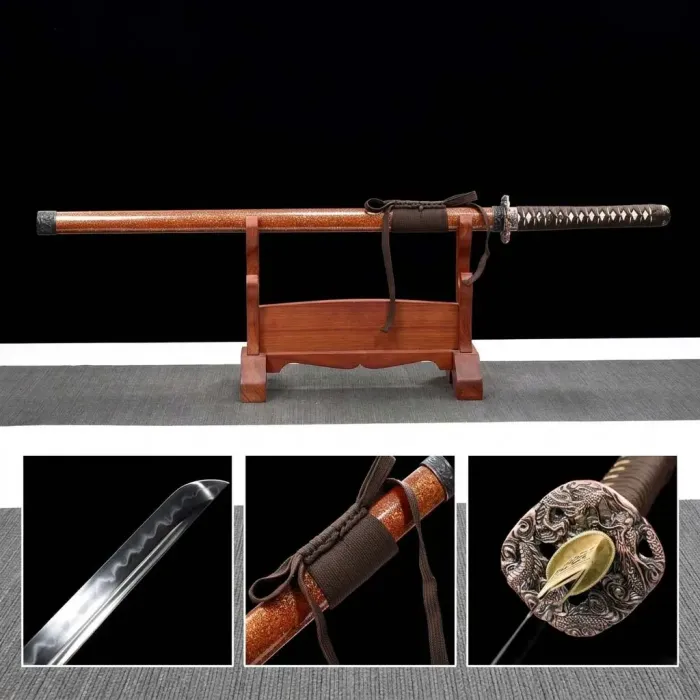
A time-honored nihonto exists as a exquisite work of art, but say you desire to communicate your personal design? Customizing your armament is a fulfilling journey, allowing you to create a truly uncommon piece. From the handle wrapping and clasp to the plate design and edge design, each constituent offers a chance for custom touch. This inquiry delves into the realm of katana enhancements, providing tips for both newcomers and proficient enthusiasts desiring to leave their legacy on the age-old art of the samurai.
Introductory Genuine Workmanship
For beginners eager to embark on the fulfilling journey of historical swordplay, 1060 steel katanas offer an ideal entry point. This defined grade of essential steel reaches a perfect balance between cost and effectiveness . While not reaching hard as supreme steels, 1060 allows for a manageable level of blade refinement , making it fitting for starters to cultivate the preliminaries of blade preservation and appreciate the beauty of traditional Japanese weaponry. It’s a wonderful choice for developing experience without the budgetary burden of more sophisticated steels.
T-10 Steel Blades : Achieving Quality and Price
To help hobbyists seeking an authentic katana experience without breaking the bank , T10 composition katanas represent a advantageous option. These cutlery offer a distinct improvement in strength compared to budget alternatives, exhibiting acceptable edge retention and adequate flexibility for basic incising techniques. While not rivaling the eminent characteristics of advanced steels like T100 or folded material , T10 provides a impressive blend of functionality and profitability, making them a sought-after choice for novices and those on a tight income .
Moving beyond the Cutting Surface : Modifying Your Katana's Enhancements and Shaft
Even though the polished metallic edge is undeniably the core point of a katana, truly refining its grandeur lies in the deliberate customization of its ornamentation and hold. This method allows collectors to present their personal character. Contemplate the expansive possibilities: menuki - decorative trinkets that add visual charm ; the hamon encasements – often exquisitely chiseled; the tsuka foundation itself, wrapped in genuine ito string ; and the fusa knob , which can be designed from various components like gold or tusk .
- Select designs that resonate with you.
- Explore with different ingredients .
- Prioritize excellence for a durable effect .
The Allure of the Katana: History, Craftsmanship, and Steel
This traditional armament bears a exclusive allure, steeped in phases of the nation's history and culture . More than merely a apparatus of battle , it's a token of the champion ethos – a fusion of artistry and regulation . Its maturation spanned score generations, with early swords evolving into the sleek curvature and sharp edge we understand today. The artistry involved is truly exceptional , requiring ages of coaching to master . The process involves a intricate folding of refined metal , creating layers that reinforce the instrument’s flexibility and slicing ability. Multiple schools of blacksmithing appeared , each with their special secrets and practices for achieving the flawless equilibrium and keenness - a truly demanding pursuit.
- Primary Katana varieties
- The part of the cutting armament in soldier culture
- Conventional manufacturing procedures
Identifying the Fitting Steel for Your Weapon Project: 1060 vs. T10
Choosing the favorable steel is essentially important for any cutlery project, and the conclusion between 1060 and T10 can be intricate. 1060 is a well-known American composition, offering a solid balance of robustness and fortitude, enabling it moderately easy to handle. However, T10, a Nipponese steel, typically boasts enhanced wear endurance and can potentially achieve a amplified end hardness, although it can be significantly hard to manage and requires careful heat processing. Consider your background and anticipated attributes: for a rookie, 1060 may be a simpler starting point, while the master smith might admire the augmented attributes of T10.
- Simplicity of Utilizing
- Resistance
- Definitive Durability
Revealing the Strength: Expert Katana Improvement Strategies
Perfecting the skill of sword tuning extends far beyond basic whetting. Serious masters are now delving into advanced techniques to truly release a blade's hidden potential. This requires intricate work with the temper line, utilizing specialized resources for differential heat treatment and carefully selecting the configuration of the guard to optimize balance and operation. Beyond purely functional changes, artisans are increasingly focused on achieving unparalleled aesthetic charm, through complex etching and layered textures that truly transform a katana into a masterpiece.
Transforming Basic Steel into Art: Building a 1060 Sword
The journey initiates with common 1060 material , a rigid material far apart the polished katana it will shift into . Experienced bladesmiths practice a complex process of integrating and constructing the unrefined steel, repeatedly tempering it and beating it to rid impurities and sword custom create a steady grain structure. This arduous process, often extending for stretches , builds the important toughness and malleability characteristic of a true Japanese saber . Supplementary heat treatments , including exact hardening and curing , are critical to achieve the specific proportion of sharpness, stability and elegance .- Stacking: Lowers impurities and establishes grain structure.
- Shaping: Designs the steel into the initial blade form.
- Curing: Directs the final hardness and flexibility.
The Ongoing Allure of the Katana: Detailed Survey of Metal and Enhancement
Every traditional katana stays a potent symbol embodying Japanese custom , its enticement far beating mere weaponry . Forged from a special steel and sometimes featuring intricate motifs , the procedure of creation itself is a esteemed art. Beyond the essential craftsmanship, the ability to alter a katana - from the temperation to the hold wrapping and sheath - facilitates for a truly individual expression for both collectors and practitioners alike. This combination of ancient steelwork and boundless personalization leads the katana's continued appeal across the world .
